Welcome to the first blog entry on this site! My decision to start writing a blog is to get into a regular practice of writing and to share my experience and perspectives on grief work, masculinity and fatherhood, soul work, non violent communication, and handcraft. This is work I have been passionate about for a long time, but always struggled to give my full focus because of other work obligations in the social service and supportive housing world. But this work is drawing me towards it and is needed more than ever. While sharing more of my experience is not always something I’m comfortable with, I also believe that it is through the healing of our wounds and the growth that accompanies it that we become more capable of supporting others.
In the last year I made a decision to step away from a 20 year career in social service work and supportive housing. I was burnt out and more importantly not feeling as though my work was aligned with what I needed for my own well being, and sanity, and that my contributions and vision were not aligned with the direction of that work in general. It was increasingly not a good fit, and so I stopped pushing against an immovable force and followed a different kind of calling. Burn out is common particularly in the social service and supportive housing world but I believe it exists in most work sectors. In my experience it is often acknowledged informally but rarely is it acknowledged formally and even more rarely do workplaces actually take some accountability for it, instead reinforcing the perspective that it is an individual problem. Burn out is a kind of spiritual, emotional and mental exhaustion. It’s not the same for everyone but it can include feeling emotionally drained, quick tempered, feeling tired all the time, or having a racing mind and an inability to focus. Ultimately it can feel as though what you are doing doesn’t really matter or lacks any purpose, and that you are stuck with no possibility of change or improvement.
All the symptoms of burnout are experienced personally, but burnout is not a personal failing or an individual fault. It is a condition of the dominant North American culture. While we experience it individually, and can come up with some coping strategies to lessen its impact, it is still a product of the current North American dominant culture and a symptom of a breakdown in relational support…or community. We are relational beings, and wired for connection. Burnout is a product of the absence of functional community or village mindedness, where we are held in community in a way that meets our needs for authenticity, connection, purpose and autonomy. It is a product of rigid and irresponsible hierarchy in a scarcity based economic model where we are forced to work harder but without any care or consideration for that effort, and increasingly for less than what was earned in previous generations. It is our soul’s exhaustion from having to work so hard for our spiritual health, and the health of others, and not being tended to through ritual, attention and care. When there is no effective community structure, we are forced to take on too much. We literally have to burn too much and we can’t sustain it.
I pursued social service work and supportive housing work because it addressed critical issues such as poverty, healing and community and seemed aligned with the kind of world, and community I wanted to live in. It took me a long time to see clearly that this was not true. At some point I will write a post specifically on the “non profit industrial complex” but what I’ve come to see as the source of my burnout was the lack of trust and transparency, rigid hierarchy, unnecessary use of power in service of those at the top, inflexible bureaucracy and the lack of accountability for all of this. The non profit industrial complex too often is complicit in creating or reproducing institutions rather than meaningful economic and community change. These are all characteristics of a colonizing culture and what I found heartbreaking was that many social service organizations and our politics for that matter, continue to operate from ways of decision making, value systems and distributions of power that are colonial in that they are rooted in a value system of unequal power sharing and grief phobia.
The challenge I felt was that a change was needed for my own sanity and soul, but I didn’t have clarity of the direction of that transformation. I needed to find myself again, and heal. So I followed my own advice and support I’ve provided to others in their healing journey.. The first thing I did was to turn towards those I love and deepen those connections. I spent time with my kids, including taking each of my kids on a camping trip. I spent time dreaming with my partner about our individual and shared dreams. I contributed in other ways to our home, such as fixing all the things that needed fixing (well kind of….), making more of our food, including bread (which we don’t buy at the store anymore). I carved spoons and explored my creativity. I was able to study with good teachers such as Francis Weller and Stephen Jenkinson. But it was also challenging and heartbreaking work. I have some elusive shadows and healing is not a sprint. It takes time and patience which at times can feel like a hopeless eternity. At times I have felt even more lost. So I spent time listening to my body, my emotions and what needed my attention. And in the spirit of Vikki Reynolds work on burnout and ethics, I understood that whatever my work was, it needed to be ethical work. I love the work of Vikki Reynolds on burnout and ethics. For me this included a shift to explore what I was being called to do. If burnout is a result of unsustainable work, I had to find what kind of work could be sustainable. Work that fed my spirit and soul.
I also turned 50. Rites of passages are moments of transition where we leave one stage of life and transition into another. They are moments where the soul calls for attention and there is an opportunity to be more attuned to the soul. For me, turning 50 has involved a turning towards this next stage of my adult life not wanting to take it for granted. With a sense of obligation to what has been entrusted to me. Many of the anxieties and worries that have been at times so much a part of myself have shifted and I have discovered the space to turn towards them with more presence and welcome them into my whole self. It is also in that space where I have worked to connect more deeply with soul. A soul’s calling is not a specific prescription for a job or career. Soul work is more mysterious and wonderful than that. It requires us to listen with depth and curiosity to what is alive in you. What kind of things bring alive your curiosity, your wonder, your spark?
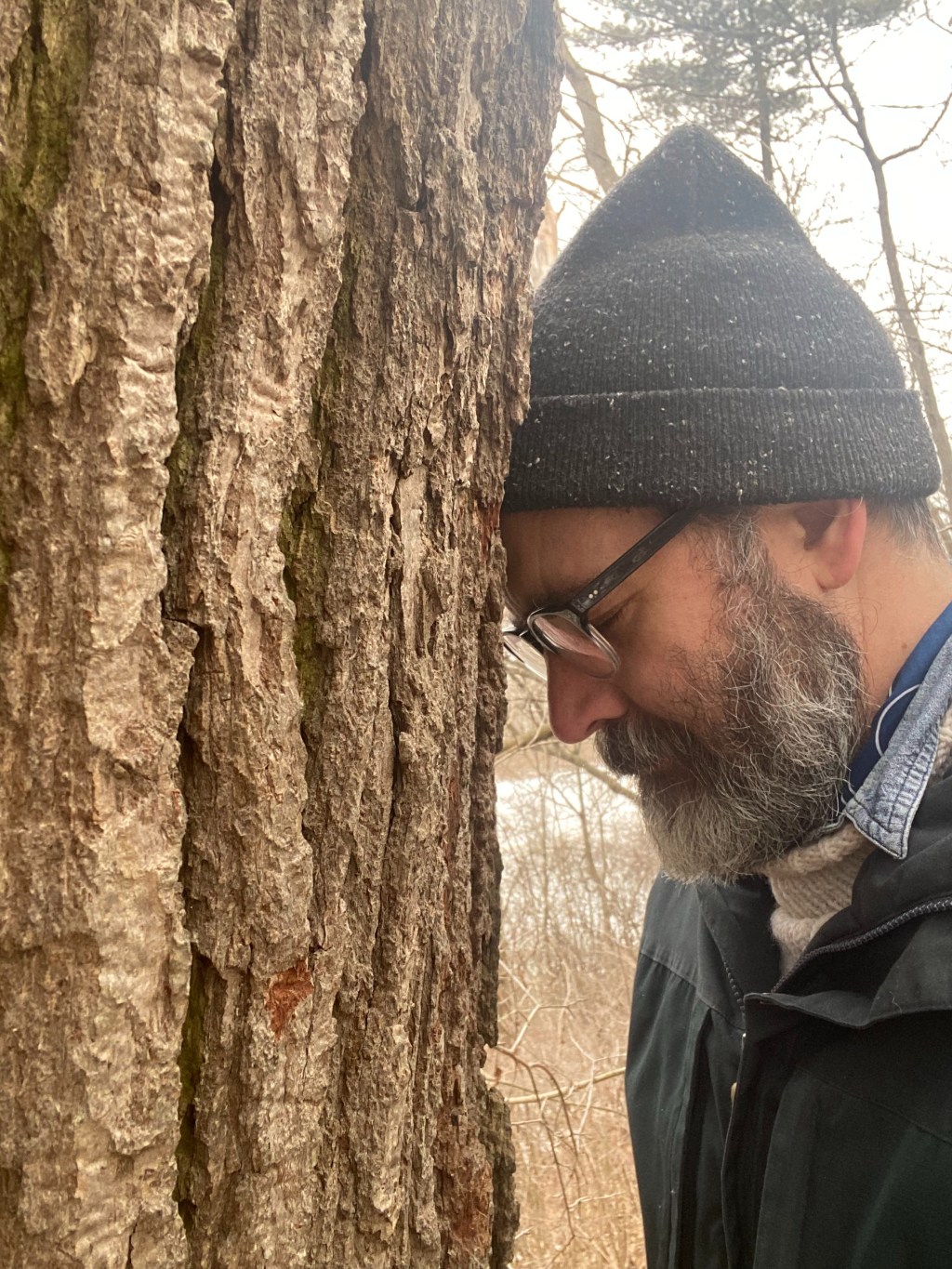
I spent more time immersed in nature. In quiet and solitude I (re)learned to experience my sense of self as deeply rooted in the earth, and that we are not separate. I studied Ecotherapy, an emerging field of work where nature is a participant in the healing process. As humans we are creations of the earth, our ancestry is rooted in relationship to the living earth, and yet we live in a time where we are less and less immersed in biodiversity and in active relationships with other beings, and more and more in spaces dominated by humans. This impacts our well being, and so healing must include attending to our relationship with the more than human world. I have found even simple practices such as forest bathing have dramatically opened up my capacity for healing.
I have found non violent communication to be an essential practice in being present with my body, my emotions, and my needs. I spend a lot of time in my head, as do many men, and what I have found is that an active mind and overthinking is a way that I have protected myself from attending to hard feelings and the unmet needs behind those feelings. NVC helps me to explore my inner world, and inner judgements with more empathy, so that I can find strategies to meet needs, rather than relying on autopilot and reactions that are protective in spirit but keep me in a loop of only meeting some needs and ignoring others. It helps me turn towards others better resourced so that I can listen with empathy and be more effective. I was especially thankful to have the opportunity to assist with the NVC Rising learning program that brought together participants from all over the globe as well as a roster of teachers and trainers from across the globe. It was an incredible experience to work on that scale and within a structure that was entirely modeled on non violent communication.
I also committed to spend time with grief. In my work I had experienced the death of many clients and had some experience in processing the grief of losing people that I cared about. But in studying with Francis Weller I realized I had a lot of grief work to do in other areas. Francis Weller and Holly Truhlar have together created a model of grief that includes 6 areas or gates of grief. The six gates are: 1-Everything we love we will lose; 2-The parts of us that have not known love; 3-The sorrows of the world; 4-What we expected and did not receive; 5-Ancestral Grief; 6-The Harms we’ve done. Most work on grief focuses on the first gate and rarely if ever are the other gates acknowledged or explored. In particular I spent time processing the grief associated with Gates 2, 3, 4 and 5, through a renewed practice in journaling, micro rituals and the practice of turning inwards with curiosity and empathy. Non violent communication in many ways provides a kind of language or framework that facilitates grief work. NVC kind of paves the road for grief work.
In a world overwhelmed with stuff made somewhere else in usually awful and soulless working conditions, and from resources that are mined without regard for the earth and her well-being, I’ve turned to making slowly handcrafted wooden spoons from local trees. I started carving spoons 10 years ago in part as a response to early experiences of burn out not just in work but also parenting young kids I like drawing and working with wood and wood carving is a nice blend of both. It is quiet work that is creative and uses my body. It also has facilitated a deeper connection to trees and forests, and I enjoy working with the material in my hands. Using hand tools means that I can work anywhere, including the woods and be in the presence of the more than human world. My impact is minimal. The antidote to a throwaway culture, is to deepen our relationships with each other and with the earth. In this culture, a key way we have some political agency is in how we spend or how we consume, and how those choices can support ethical labour and environmental practices. I think another consideration is our relationship with the living earth and with the human community and the kind of culture we can create by these choices. Bringing more handcraft into our lives means that the objects we use regularly and that compose our living spaces can reinforce relationships we have with other people, including the makers, as well as places where the materials come from.
In some of my hastily scribbled notes from listening to Stephen Jenkinson, he suggested that when you are born to a troubled time, you could be disappointed and complain about your circumstance, or you could take it as an assignment. We live in a grievance culture, and it is hard to resist the temptation to join in and complain about how messed up things are and how it’s all someone else’s fault. But to take it as an assignment requires us to consider that we have value, and that we are needed in these times. There is much more to work with, if we lean into the perspective that we have gifts that are our reason for being here. Purpose then isn’t found outside ourselves, but rather within. We already have it.
My partner has been incredibly supportive in my healing and learning journey. She has been on a similar journey herself and our growth and healing has been shared in support and reverence for each other. She has helped me find myself. I have been delighted to bask in her wisdom and many of my practices are indebted to her. Every year she has a practice of choosing a word for the year, that is a guide but also an opportunity for getting into the depths of what the meaning in that word asks of us.
Last year my word was Rooted. I spent time exploring what roots I wanted to grow, what I wanted to be rooted to, building a stronger foundation of practice as I navigated some big changes. This year my word is Becoming. It’s an opportunity to embrace a journey as I haven’t yet arrived, but I am for certain on the path. I can explore what practices can help me shape what I am becoming, and what is hindering that journey that I can let go of. I also appreciate that the ‘be’ suggests an attunement to the present moment, and so when it is joined in ‘becoming’ it is a reminder that we can’t be overly future focussed. Perhaps we are always in a state of becoming, and that is perhaps more of a state of ongoing transformation, not unlike the annual cycle of plants…. allowing of ourselves to take root in good soil that nourishes us so that we can grow and blossom, and then let go of what no longer is needed, return to the earth and repeat over and over.
Thank you for reading this far! My plan is to write a post once a month, continuing to share from my personal experience as well as what I see as useful strategies and practices for dealing with some of these big issues of our times. I will end by sharing a threshold walk exercise, one of my favourite practices for connecting with spirit and soul.
Wild wander/Threshold walk (20-30 minutes):
*you may consider walking barefoot for this exercise.
Go for a walk in the wild in search of a threshold, or a gateway into sacred space. The threshold cannot be human made, such as a gate or human made path.
Practice the etiquette of the wild. Be rooted in soul. You must be led by your gut. Consider that the quality of your attempt, it’s vulnerability, it’s openness, it’s wildness, has consequence for your soul and for your relationship with your ancestors and the more than human world. Practice discipline, and watch that your mind doesn’t separate from your body and hijack the experience. You can’t push it or even try…it will weaken the encounter. Focus on your awareness and connection to the living world around you. It may be helpful to focus your attention on your breath and your heart, or your feet touching the ground. Go where you are drawn.
Let your aliveness guide you and you will know it when you encounter it. Honour yourself and trust what is revealed to you.
Once you pass through the threshold, then you must shift into a different consciousness. You are wandering led by longing.
Walk as your wild self, and be present and attentive in all your senses. Go slowly.
Taste the air.
Use a soft gaze.
Listen with depth.
Feel every step through your feet.
Go to what you are drawn to. Find a being that invites you to sit.
Tell it what led you to it. Introduce yourself as the one who said yes to it.
Talk about the longing that led you there.
Don’t hold back. What you have say is needing to be heard.
Speak until you have nothing left to say. Spend some time listening to the wild.
When you are complete say thank you.
 Joel Regehr
Leave a comment